
Never Miss an Update
Subscribe to PepTalk and get the latest FDA updates, research highlights, and industry news delivered straight to your inbox.
Never Miss an Update
Subscribe to PepTalk and get the latest FDA updates, research highlights, and industry news delivered straight to your inbox.
Never Miss an Update
REGULATORY
•
Are Peptides Safe? What the Evidence Actually Says
Are Peptides Safe? What the Evidence Actually Says
Are Peptides Safe? What the Evidence Actually Says
Are Peptides Safe? What the Evidence Actually Says

By PepMed Editorial Team
By PepMed Editorial Team
PepMed Updates
PepMed Updates


Important Takeaway
Peptide safety cannot be judged as a single category. Some peptide medications have substantial human evidence, while others have limited or no reliable human safety data.
Peptide safety cannot be judged as a single category. Some peptide medications have substantial human evidence, while others have limited or no reliable human safety data.
Peptide safety cannot be judged as a single category. Some peptide medications have substantial human evidence, while others have limited or no reliable human safety data.
Peptides have become increasingly visible in conversations about weight loss, recovery, healthy aging, skin health and performance. That has also created an important question:
Are peptides actually safe?
The answer depends on which peptide you're talking about.
Peptides are a broad class of molecules made from chains of amino acids. Some peptide-based medications have been extensively studied and approved by the FDA. Others are being investigated in clinical research, while some popular peptides have very little human safety data.
That means describing all peptides as either "safe" or "unsafe" can be misleading.
Are All Peptides the Same?
No.
The word peptide describes a type of molecule—not a single medication or treatment.
Some peptides occur naturally in the human body. Others have been developed into prescription medications. Still others are experimental compounds being investigated for potential medical uses.
The amount and quality of evidence can therefore vary dramatically from one peptide to another.
An FDA-approved peptide medication has undergone regulatory review for a particular indication, formulation and patient population. That doesn't mean the medication is risk-free, but its benefits, risks, dosing and adverse effects have been evaluated through a formal approval process.
Experimental peptides are different. In some cases, much of the available research may come from laboratory or animal studies rather than large human clinical trials.
What About Compounded Peptides?
Compounding adds another important distinction.
Compounded medications can serve a legitimate medical need when an FDA-approved medication isn't appropriate for a particular patient. However, compounded drugs themselves are not FDA-approved.
FDA does not review compounded drugs for safety, effectiveness or quality before they are marketed. The agency also warns that poor compounding practices can result in problems such as contamination or incorrect amounts of active ingredient. U.S. Food and Drug Administration
That doesn't mean every compounded medication is unsafe. It means compounded and FDA-approved medications should not be treated as though they have undergone the same regulatory review.
What Does the FDA Say About Popular Peptides?
This is where looking at individual peptides becomes especially important.
FDA currently identifies potential safety concerns or significant gaps in human safety information for several substances commonly discussed in the peptide community. U.S. Food and Drug Administration
Peptide | What FDA currently says |
|---|---|
FDA has identified no or only limited safety information for proposed routes of administration and notes potential immunogenicity and impurity concerns. | |
Human safety data are limited, and FDA identifies potential immunogenicity concerns related to aggregation and peptide impurities. | |
KPV | FDA says it has not identified human exposure data and lacks important safety information. |
MOTS-C | FDA says it has not identified human exposure data and lacks important safety information. |
Semax | FDA reports no or limited safety information for proposed routes and identifies potential immunogenicity concerns. |
TB-500 | FDA says it has not identified human exposure data for the thymosin beta-4 fragment and lacks important safety information. |
Importantly, lack of evidence that something is harmful is not the same as evidence that it is safe.
FDA's Pharmacy Compounding Advisory Committee also specifically considered BPC-157, KPV, TB-500 and MOTS-C-related substances at its July 2026 meeting, demonstrating that regulatory evaluation of these substances continues to evolve. U.S. Food and Drug Administration
What Are the Potential Risks of Peptides?
There isn't one universal list of "peptide side effects."
Side effects depend on the specific peptide, dose, route of administration, formulation and individual patient.
For experimental or compounded peptides, additional questions can include product purity, sterility, dosing accuracy, peptide-related impurities and immune responses.
Injectable products make manufacturing and sterility especially important because contamination can create risks independent of the peptide's biological effects.
FDA notes that poor-quality compounded drugs can contain too much or too little active ingredient or become contaminated, potentially resulting in serious harm. U.S. Food and Drug Administration
How Can You Evaluate Whether a Peptide Is Safe?
Rather than asking whether peptides as a whole are safe, consider six questions:
What exact peptide is being considered?
Is it FDA-approved for the intended use?
What human clinical evidence exists?
Where is the medication being obtained and manufactured?
Is a licensed healthcare provider determining whether it's appropriate?
What side effects, interactions and monitoring requirements apply to that specific treatment?
These questions provide much more useful information than assuming every product described as a peptide has the same evidence or risk profile.
So, Are Peptides Safe?
Some peptide-based medications have substantial clinical evidence and well-characterized safety profiles. Others remain experimental and have major gaps in human safety data.
That's why the better question isn't simply:
"Are peptides safe?"
It's:
"What do we actually know about the safety of this specific peptide, for this specific use, in this specific patient?"
That distinction matters.
Medical Disclaimer: This content is provided for educational and informational purposes only and does not constitute medical advice, diagnosis, or treatment. Reading this content does not establish a provider-patient relationship with PepMed. Always consult a qualified healthcare professional regarding your individual health and treatment decisions. [Read our full Medical Disclaimer]
Medical Disclaimer: This content is provided for educational and informational purposes only and does not constitute medical advice, diagnosis, or treatment. Reading this content does not establish a provider-patient relationship with PepMed. Always consult a qualified healthcare professional regarding your individual health and treatment decisions. [Read our full Medical Disclaimer]

Access. Trust. Convenience.
A new era of Physician guided care.
_________
PepMed connects you with licensed physicians and personalized care - anytime, anywhere.




COMING SOON
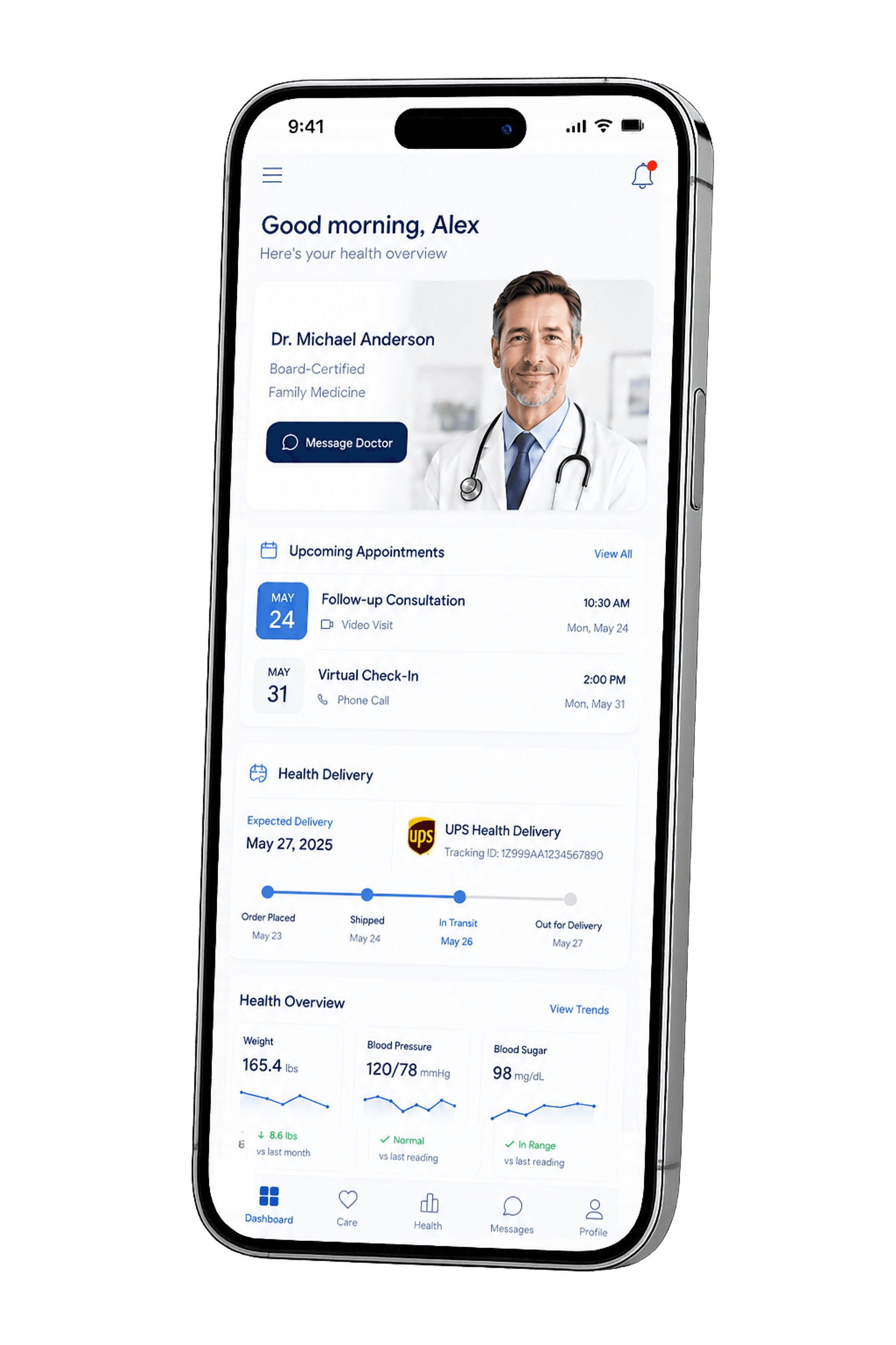
The PepMed mobile app.
Access consultations, health insights and more - all from your phone.


Stay tuned for launch updates.
PepTalk Updates
New articles, platform news and launch announcements


Virtual Care
Connect with licensed providers from wherever you are.

Treatment Access
Treatment options prescribed by licensed healthcare providers.

See Your Progress
Appointments, delivery tracking and health trends in one place.
© 2026 PepMed. All rights reserved
Access. Trust. Convenience.
A new era of Physician guided care.
_________
PepMed connects you with licensed physicians and personalized care - anytime, anywhere.
COMING SOON
The PepMed mobile app.
Access consultations, health insights and more - all from your phone.
PepTalk Updates
New articles, platform news and launch announcements
Virtual Care
Connect with licensed providers from wherever you are.
Treatment Access
Treatment options prescribed by licensed healthcare providers.
See Your Progress
Appointments, delivery tracking and health trends in one place.
© 2026 PepMed. All rights reserved